
Glossary
Masonry Glossary
Bond, course, lintel, spalling: the words masons use, explained in plain English. Search or scroll.
- Arch
- A curved structure that carries the load above an opening through the shape of the bricks.
- Batter
- The slight backward lean of a retaining wall, which helps it resist the soil behind.
- Bond
- The pattern in which bricks are laid, such as running, stack or Flemish. It affects both the look and the strength of a wall.
- Compaction
- Packing soil or stone tightly with a plate compactor so it does not settle later.
- Concave joint
- A joint tooled into a curved shape. It sheds water well and is the most common choice.
- Control joint
- A planned gap that lets masonry or concrete move without cracking.
- Coping
- The cap on top of a wall that protects it from rain.
- Corbel
- A masonry piece that steps outward from a wall to support something above or as decoration.
- Course
- One horizontal row of bricks or stones in a wall.
- Crown
- The sloped slab that covers the top of a chimney and sheds water away from the flue.
- Damper
- A plate in the throat of a fireplace that opens for a fire and closes when it is not in use.
- Efflorescence
- A white, powdery salt deposit left on masonry when water moves through it and evaporates.
- Firebox
- The chamber of a fireplace where the fire burns, lined with firebrick.
- Flashing
- Thin metal or membrane that directs water out of a wall at openings, bases and rooflines.
- Flue
- The passage that carries smoke and gases out of a fireplace or appliance.
- Footing
- A concrete base under a wall or column that spreads the load to the ground.
- Frost line
- The depth to which the ground freezes in winter. Footings are set below it.
- Geogrid
- A strong plastic mesh laid between courses and tied into the soil to reinforce a taller retaining wall.
- Header
- A brick laid with its short end showing, tying two layers of a wall together.
- Hearth
- The floor of a fireplace and the area in front of it, built of non-combustible material.
- Joint
- The mortar-filled space between bricks or stones.
- Lintel
- A beam over a window or door that carries the weight of the masonry above.
- Mortar
- The mix of cement, lime and sand that bonds masonry units together.
- Paver
- A flat unit of brick or concrete laid to form a patio, walk or drive.
- Polymeric sand
- Fine joint sand with binders that harden when wet, locking pavers together and slowing weeds.
- Raked joint
- A joint with the mortar scraped back from the face. It makes deep shadows but can hold water.
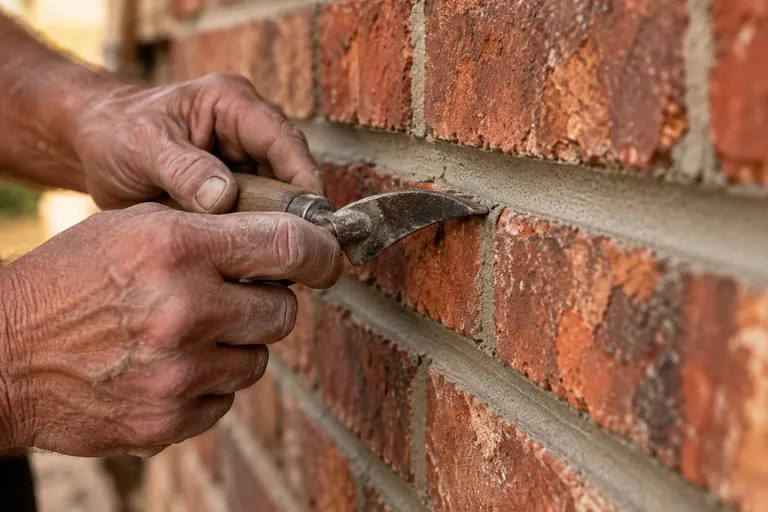
- Repointing
- Removing worn mortar from joints and replacing it with new mortar.
- Rowlock
- A brick set on its long edge so the short face shows. Used in sills and arches.
- Screed
- To level a layer of sand or concrete by drawing a straight edge across it.
- Soldier
- A brick set on end, standing upright, with its narrow face out. Often used in borders and above openings.
- Spalling
- The flaking or breaking off of the face of brick or stone, often from water freezing inside it.
- Stretcher
- A brick laid with its long side showing in the face of the wall.
- Tuckpointing
- A fine technique of filling joints with mortar and adding a thin contrasting line to make them look crisp.
- Veneer
- A single thin layer of brick or stone fastened to a wall, as opposed to a solid masonry wall.
- Wall tie
- A metal strap that fastens a veneer to the wall behind it or joins layers of masonry.
- Weep hole
- A small opening at the base of a wall that lets trapped water drain out.
- Wythe
- A single vertical layer of masonry that is one unit thick.
No match. Try a shorter word.
Still have a question?
Describe your project and we will explain it in plain English.